
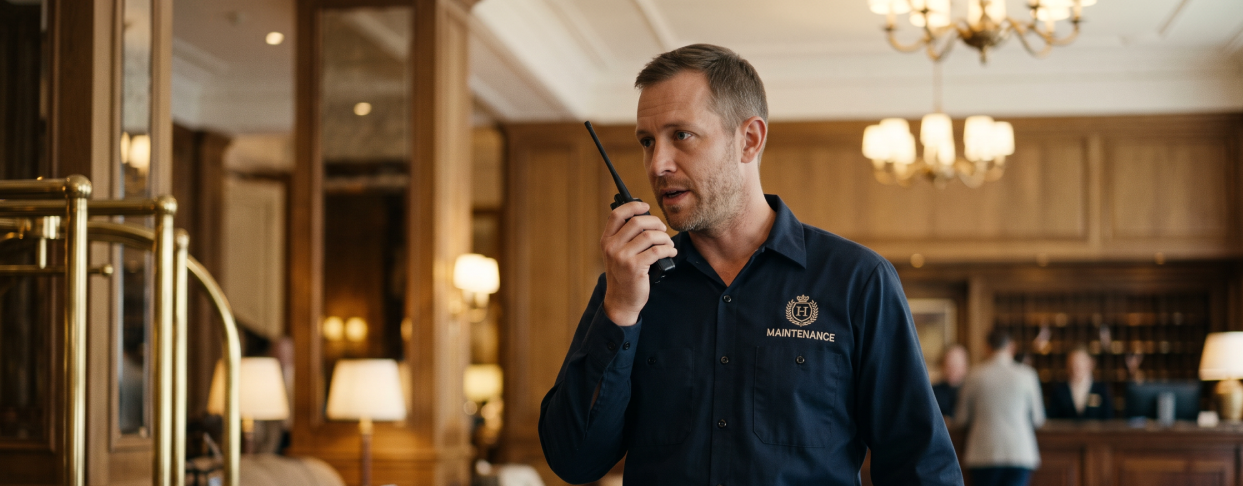
If you're running a hotel or resort, or you're an independent operator juggling multiple properties, here's something you already know but maybe haven't said out loud: the biggest profit leaks don't happen where guests can see them. They happen in the blind spots between departments, when housekeeping knows something the front desk doesn't, or the front desk promises something engineering never heard about.
The problem is often not the employee but an operation that depends on verbal updates, radios, paper logs, and disconnected systems. In this blog, we see how we address this from both sides: remote management services that coordinate daily operations, and a connected tech stack combining Dharma OPS, an integrated PMS, and channel management.
Anatomy of a Handoff Failure
Here's how one unrecorded detail turns into a mess across three departments.
The guest is told at 10am, early check-in works. Nobody updates housekeeping's list. The housekeeper is cleaning a room on the other side of the property off a printed sheet from an hour ago. The guest is standing in the lobby with two suitcases. The front desk tries the radio, no answer, and has to walk the floor looking for someone. That's the front desk to the housekeeping gap. Priority changes get passed by word of mouth that get lost on a busy morning, every time.
A housekeeper notices the AC in 214 is barely cooling. She mentions it, or writes it on a clipboard in the linen room. Engineering is handling three other jobs. Nobody creates a work order for 214. Two nights later the guest in that room calls the front desk at midnight, furious, and now you're dealing with a situation that could’ve been avoided.
What does this actually cost? You can track the losses in revenue or staff-hours lost in resolving the issues. But there’s a cost you cannot put a number on: guest trust and the morale of a team that has to face angry guests, every time.
So the real question isn't “Which department messed up?” It's “which part of our operational processes lets the mistake reach the guest.”
Where Handoffs Actually Break (It's Not Just Shift Change)
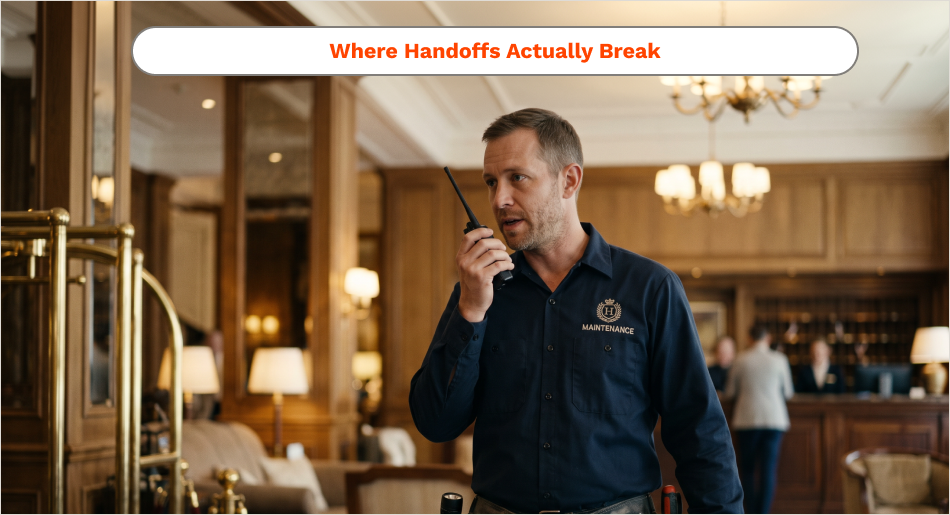
Most operators think of handoffs as the morning employee handing over to the afternoon employee. In reality, your hotel is handing work over all day.
Walkie-talkies are useful when something needs immediate attention. But a radio call is not a permanent operational record. Everyone hears the message. But who owns it? Has someone accepted it? When did they start? Was it fixed? Who checked it afterward?
Whatsapp, PMS notes, and paper logs have the same issues. You might be thinking, we've run on radios and shift logs for fifteen years—why do we need software to tell our staff how to talk to each other? That's a fair question.
The point of operational software is not to teach your team how to communicate. Your team keeps talking exactly the way they always have. The difference is every request ends up as a record with a name, a timestamp, and a status. Radios were never really the issue. The issue is radios leave nothing behind once the conversation is over.
What This Looks Like When Departments and Properties Are Distributed
Now scale the miscommunication and hand-off issues across a resort, several independent hotels, or a portfolio of serviced apartments. The “next shift” or the “remote team” may not even be in the same building or time zone.
That is why written, structured handoff processes become non-negotiable in distributed operations. The request needs an owner, status, priority, and confirmation of completion. The next person should not have to reconstruct what happened from six messages and yesterday's shift notes.
The operator takeaway is simple: reliable properties treat handoff as a designed process with ownership and confirmation, not a habit employees are expected to remember.
How Dharma Eliminates Interdepartmental Handoff Risks
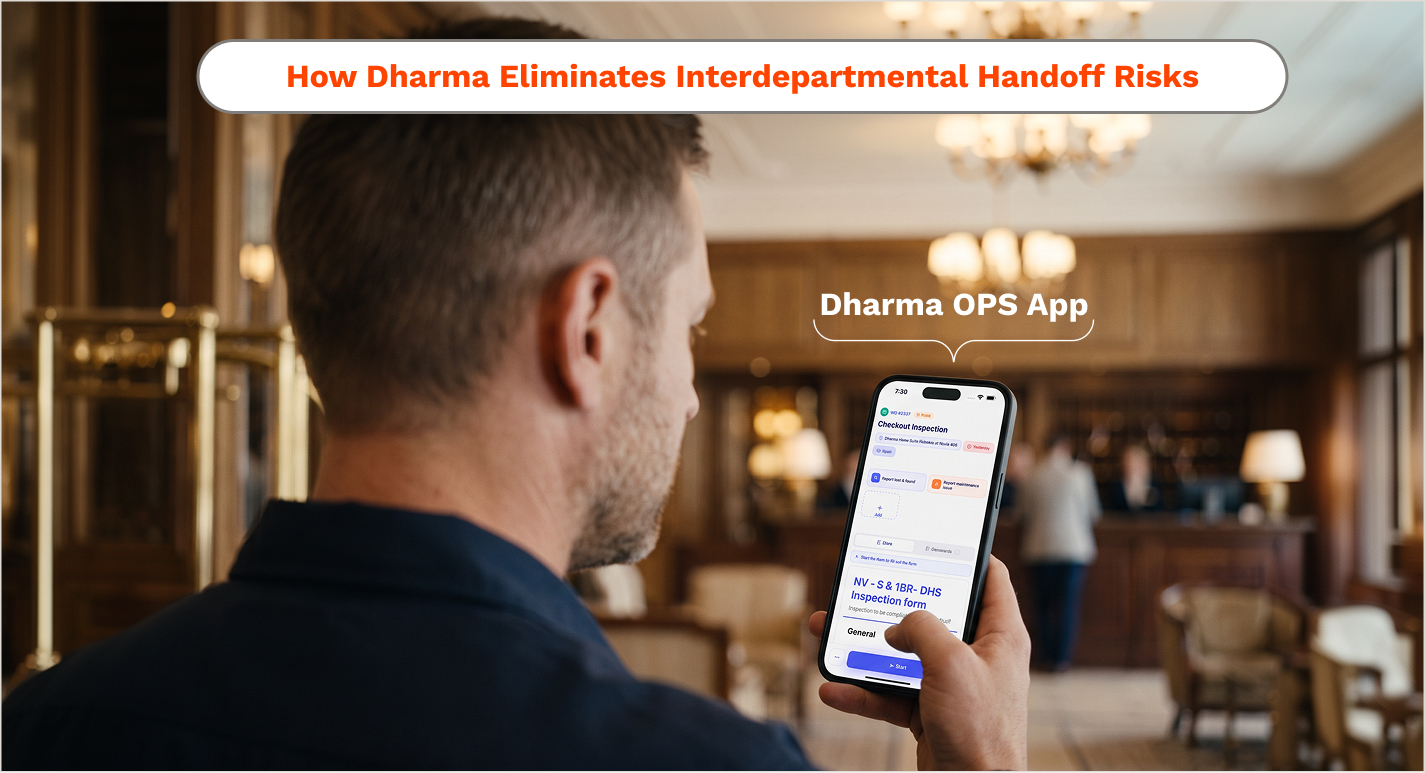
This is where we combine Dharma Services with Dharma Tech (PMS + OPS).
- One team, one owner: Dharma's remote operations service manages daily work, including guest communication, reservations, housekeeping coordination, and maintenance follow-up. Instead of a guest request being repeatedly passed between disconnected teams, the request can remain tracked through resolution.
- One record, multiple team logs: Dharma OPS centralizes housekeeping, maintenance, and other operational work. Work orders have designated owners, and teams can see what needs to be done, who is responsible, and when it is due. So when the next shift starts, staff are not trying to reconstruct the previous eight hours from radio conversations and handwritten notes. They can see the work.
- PMS and channel manager stay in sync: Dharma's current hotel technology stack combines LosjiTech PMS with SiteMinder's Channel Manager and Booking Engine, alongside Dharma OPS. The goal is to remove unnecessary manual relay between the systems managing reservations and distribution and the operational teams executing work at the property.
- Overnight coverage that doesn't drop: A skeleton night team should not mean requests disappear until morning. Dharma's remote services include after-hours guest support, while OPS provides task tracking and centralized issue management. A late-night request can therefore be recorded and followed instead of becoming a verbal note somebody has to remember at shift change.
Turning Hospitality Handoffs into Revenue
Hospitality profitability is not only won through higher occupancy or better marketing. A lot of it comes from a guest standing in the lobby and an AC that nobody fixed. Your hospitality operations must be such that the guest does not have to become the person who discovers that your internal handoff failed.
That is the thinking behind Dharma Services and OPS. It was built from real hospitality operations, where a small communication gap between two teams can quickly become a much bigger operational problem.
Reduce handoff gaps before they turn into guest complaints and lost revenue. Explore Dharma’s remote management services and hospitality tech stack, or book a call with our team to see how it can work for your property.