


If you manage a hospitality business, you probably have access to a lot of information.
Your PMS shows reservations and occupancy. Financial reports tell you how the properties are performing. Your maintenance system has its own list of open issues. Housekeeping has schedules, your team has messages and task lists, and there may be several other tools involved in keeping everything moving.
None of that is a bad thing. In fact, these systems are useful for running a property. The challenge comes when you need to put all of that information together.
You might know that occupancy is up, for example, but do you also know whether your team is keeping up with the workload? Are maintenance issues taking longer to resolve? Are the same guest complaints coming up repeatedly? Is one property requiring considerably more attention than the others?
Finding those answers can take more work than it should.
This is where operational visibility becomes important. It is not about collecting more data. It is about having enough context around that data to understand what is happening across your properties and where attention is needed.
Why More Hospitality Data Doesn’t Always Mean More Visibility
Hospitality businesses generate a lot of data every day. Reservations come in, guests check in and out, work orders are created, tasks are completed, payments are processed, and teams communicate about dozens of small things that keep a property running. The information is there. The problem is that it often scatters wildly in different places.
An owner might open the PMS to check occupancy, then look somewhere else for a maintenance update, ask a team member about a guest issue, and later receive a report with numbers that don't include any of that operational context.
Isolated data points offer useful snapshots, but without context, connecting them is a challenge. That gap matters because true property performance is the result of multiple moving parts composing the whole picture, not just one metric.
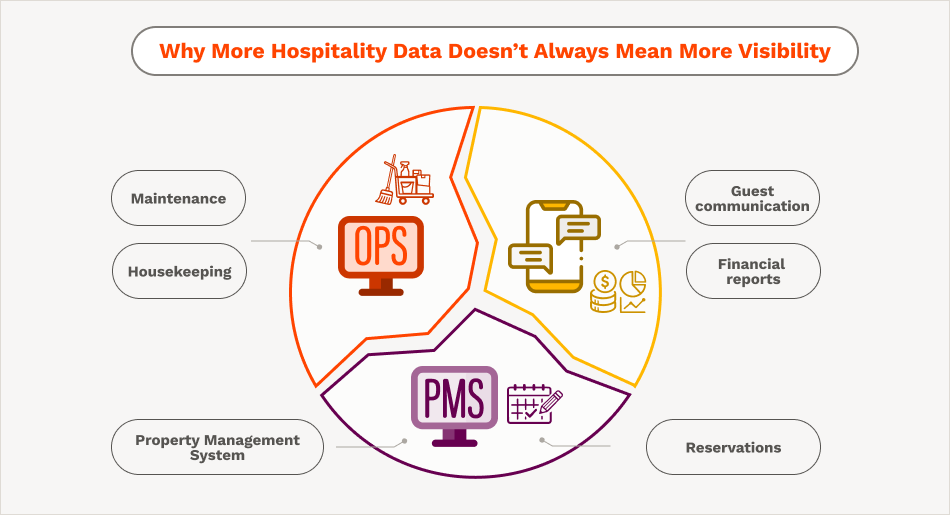
A property can have strong occupancy and still have operational problems. A good month financially doesn't necessarily mean the team is working efficiently. A few negative reviews might seem insignificant until you realize they are all mentioning the same unresolved issue.
This is why hospitality reporting should do more than present numbers but also should help owners understand what those numbers mean in the context of the operation.
If a report shows that something changed, the next question should be fairly simple:
Why did it change, and does someone need to do something about it?
That is much more useful than having another dashboard full of information that still requires you to investigate the answer yourself.
What Operational Visibility in Hospitality Actually Looks Like
So, what does operational visibility in hospitality look like in practice?
It means being able to get a clear picture of your properties without having to chase down information from different people and systems.
That picture can include the things you would expect to see in a typical property report, such as:
- Occupancy, revenue, ADR, and other property performance indicators
- Current and upcoming reservations
- Maintenance issues and open work orders
- Housekeeping and other operational tasks
- Team activity and task completion
- Guest issues and how they were handled
- Recurring problems, preventive maintenance, and patterns across properties
The important part is not simply having all these data points but also being able to see how they relate to one another.
Take maintenance as an example. If one property has an unusually high number of work orders, that is worth knowing. But it is even more useful to know what those work orders are about, how long they have been open, who is handling them, and whether similar issues have been reported before.
Without the operational context, it is easy to look at a number and make the wrong assumption.
This is one of the reasons centralized hospitality operations can make such a difference. When information is spread across several systems, it takes time to connect the dots. When the relevant information is brought together, it becomes easier to see what needs attention.
And if you are managing several properties, that becomes even more valuable. You should be able to compare what is happening across your portfolio without having to start an investigation every time something looks unusual.
What Good Hospitality Reporting Should Tell You
Reports are useful when they help you make decisions.
If a report tells you that maintenance requests increased by 20%, for example, that is good to know. But the more useful questions are: What caused the increase? Is it concentrated in one property? Is there a recurring issue? How quickly are those requests being resolved?
Those answers give you somewhere to start.
This is where hospitality operational reporting and hospitality analytics become more useful. Instead of looking at performance in isolation, you can use the information to identify operational bottlenecks, recurring issues, or areas where a property may need additional attention.
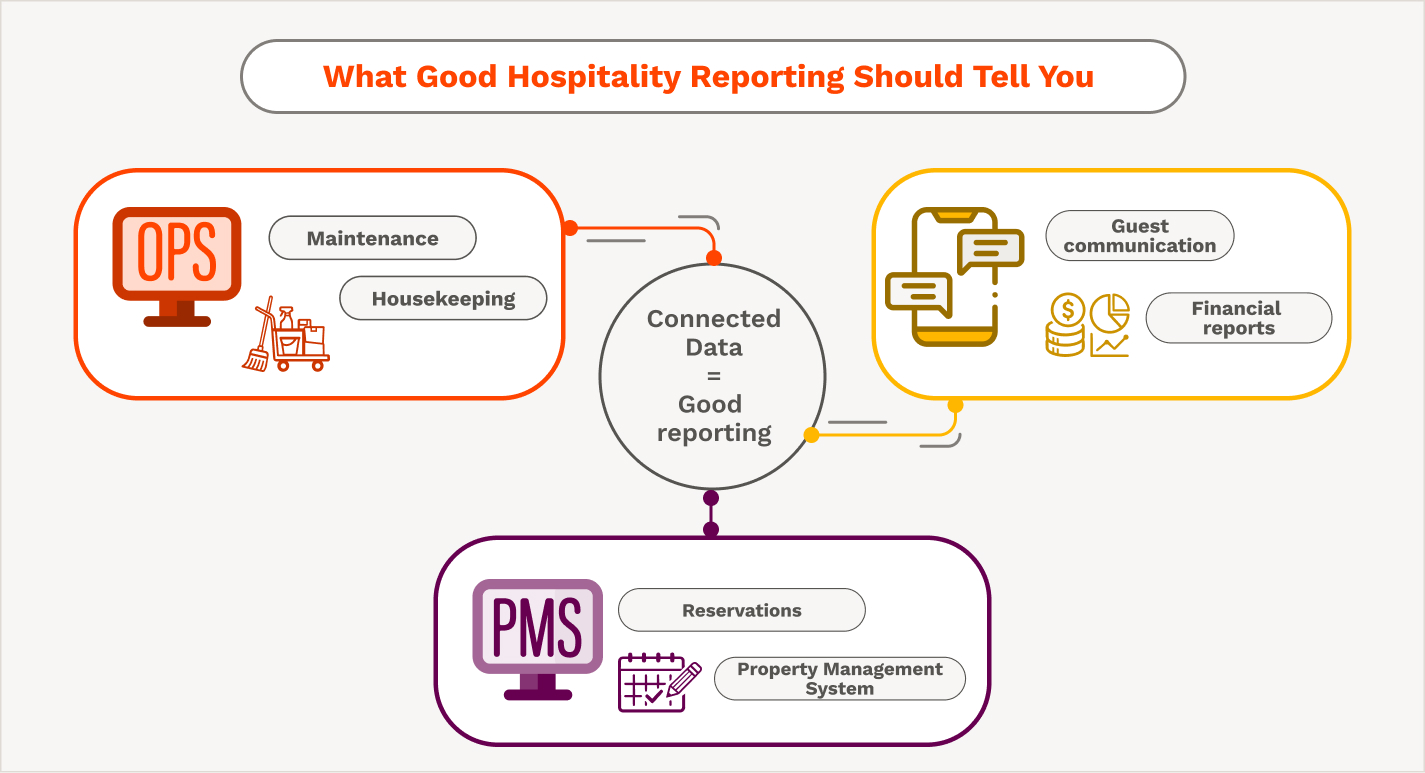
The same principle applies to team workflows. If tasks are regularly overdue, you need more than a list of overdue tasks. You need to understand why they are overdue. Are they being assigned to the right person? Are priorities clear? Is the workload reasonable? Is there a recurring issue that keeps generating additional work?
Having visibility into the workflow makes those questions easier to answer.
It also gives owners something that is often missing when operations are spread across different tools: a clear view of what is being done about an issue.
Knowing that a guest reported a problem is one thing. Knowing that it was assigned, someone followed up, and it was resolved gives you a much better understanding of the situation. For property owners, that visibility also provides peace of mind. Even when they are not involved in every operational detail, they can see that issues are being handled and know there is a clear process behind them.
That transparency is particularly useful when you are not involved in every day-to-day decision. You don't necessarily need to manage every task yourself. You need to know that the right tasks are being handled and be able to see when something requires your attention.
How Technology Can Connect Your Hospitality Operations
Technology can help solve part of this problem, but the answer isn't necessarily another piece of software. Most hospitality teams already have plenty of tools, what matters is how well those tools and the information they contain work together.
A centralized operations platform can bring operational information, workflows, communication, work orders, and task management into one place. When it is connected with a PMS and other hospitality systems, owners and teams can get a more complete view of both property performance and the work happening behind it.
This is where effective reporting tools prove their benefits. The idea is to generate more data but also to ensure that critical information is accessible, intuitive, and truly valuable.
For example, reservation information can help teams prepare for upcoming stays. A maintenance issue can be connected to a specific property or unit. A recurring guest complaint can point to an operational problem that needs to be addressed.
That connection is important for hospitality business intelligence because performance data rarely tells the entire story on its own.
A change in occupancy is a number, and understanding what that change means for housekeeping, maintenance, staffing, or guest service is the operational context.
Technology can help bring those pieces together. But the technology itself does not automatically tell you what to do with them. That is where the hospitality experience still matters.
How Dharma Brings Hospitality Technology and Operations Together
At Dharma, we believe technology works best when it is connected to the people and processes using it.
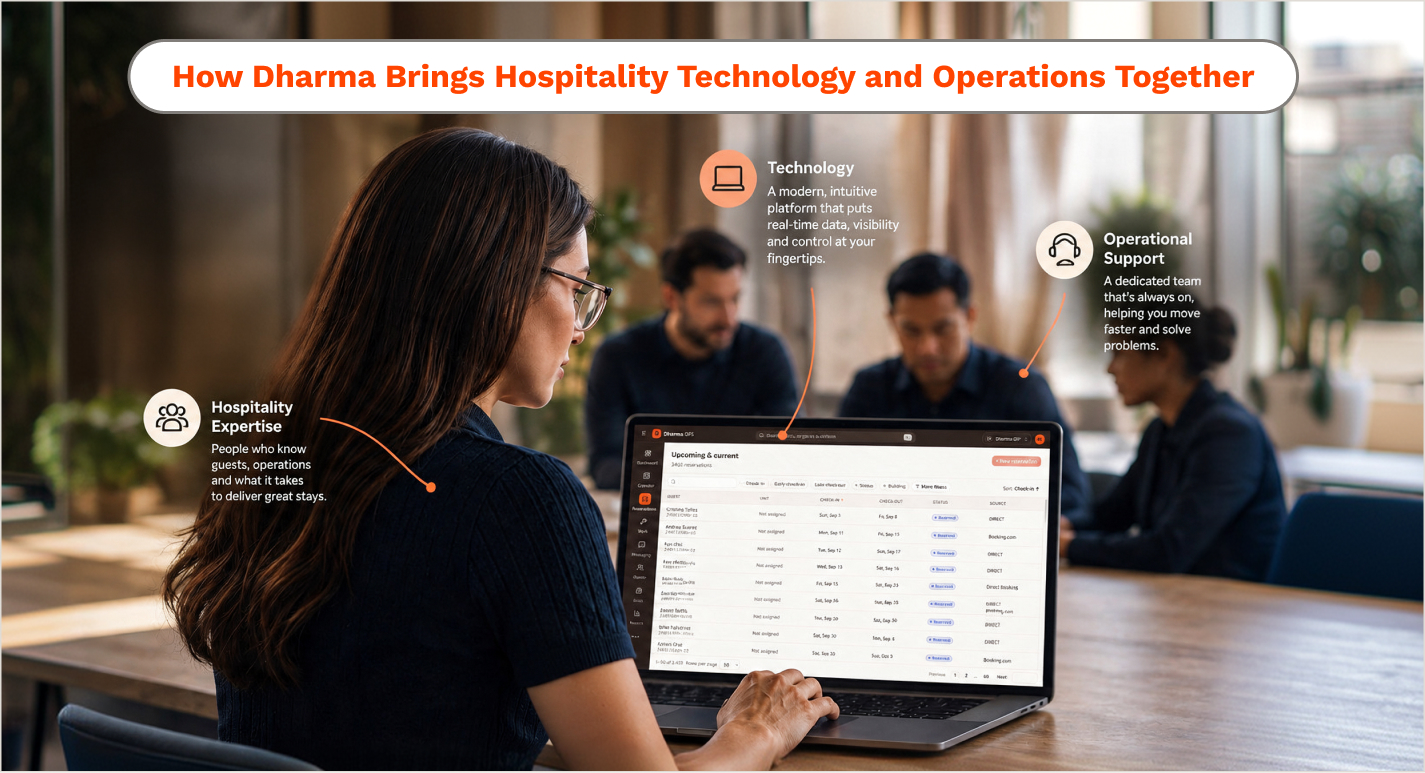
That is why our approach combines hospitality expertise, technology, and operational support.
Our Operations Platform brings together the information teams need to manage day-to-day operations, including tasks, work orders, communication, workflows, and reporting. Our PMS and channel management capabilities connect the operational side with reservations and distribution, helping create a more complete view of each property.
But Dharma is not only providing the technology; our team can also take on the operational work behind it. That means owners and operators can have access to the information they need without having to personally coordinate every task, follow up on every issue, or manage every operational detail.
For an owner, that can mean checking in on a portfolio and quickly understanding where things stand instead of opening several systems and starting a round of messages to find out.
It can also mean spotting a recurring issue earlier, understanding what the team is doing about it, and making decisions based on more than a single performance metric.
That is what we mean by operational visibility. A clearer view of how your properties are performing, what is happening behind the numbers, and where your ground team needs support.
Ready to see what better operational visibility could look like for your business?
Dharma combines hospitality services with the technology and operational expertise to support them. Talk to our team to see how our tech and services can help you get a clearer view of your properties and simplify the work behind them.